
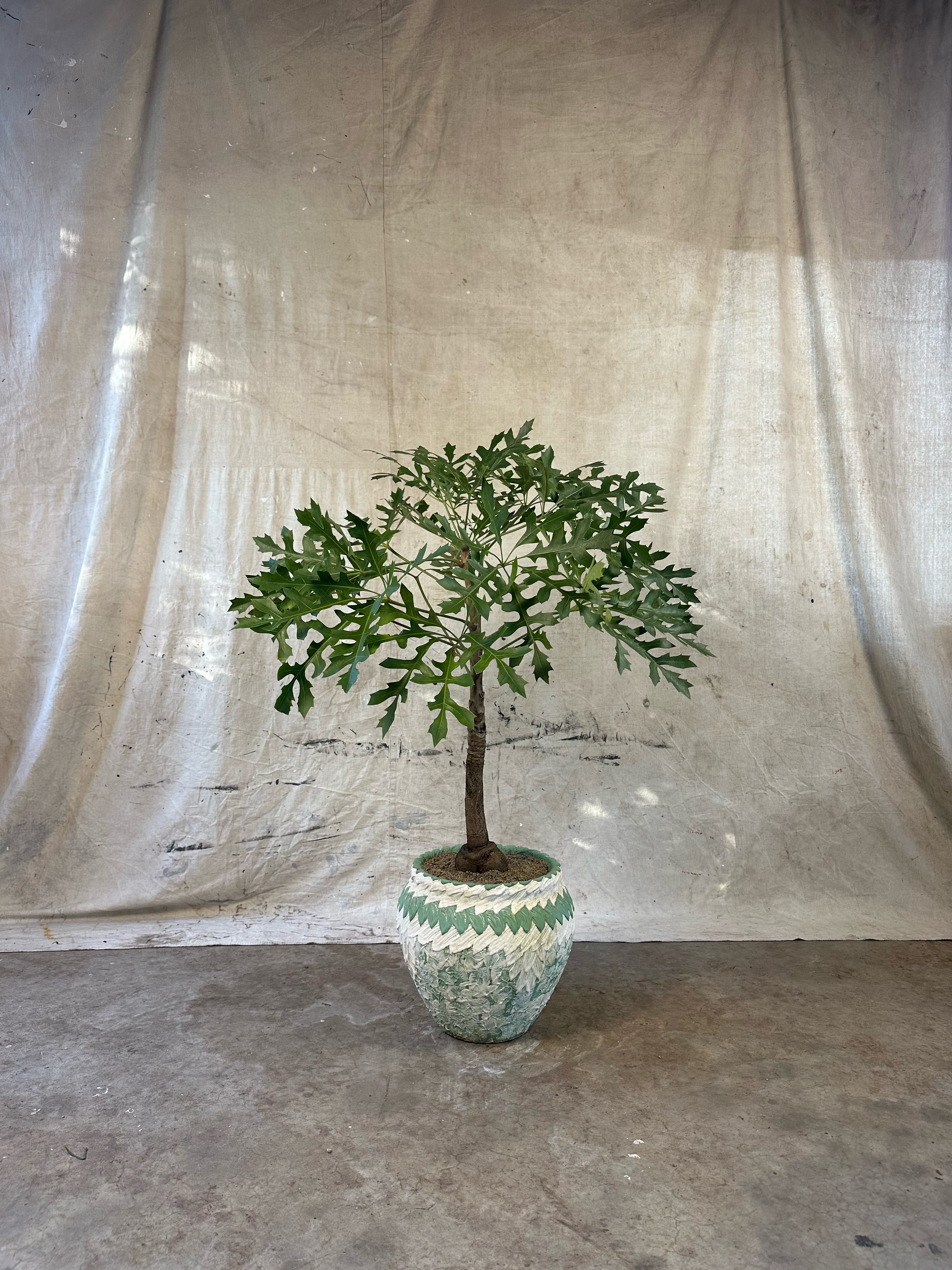
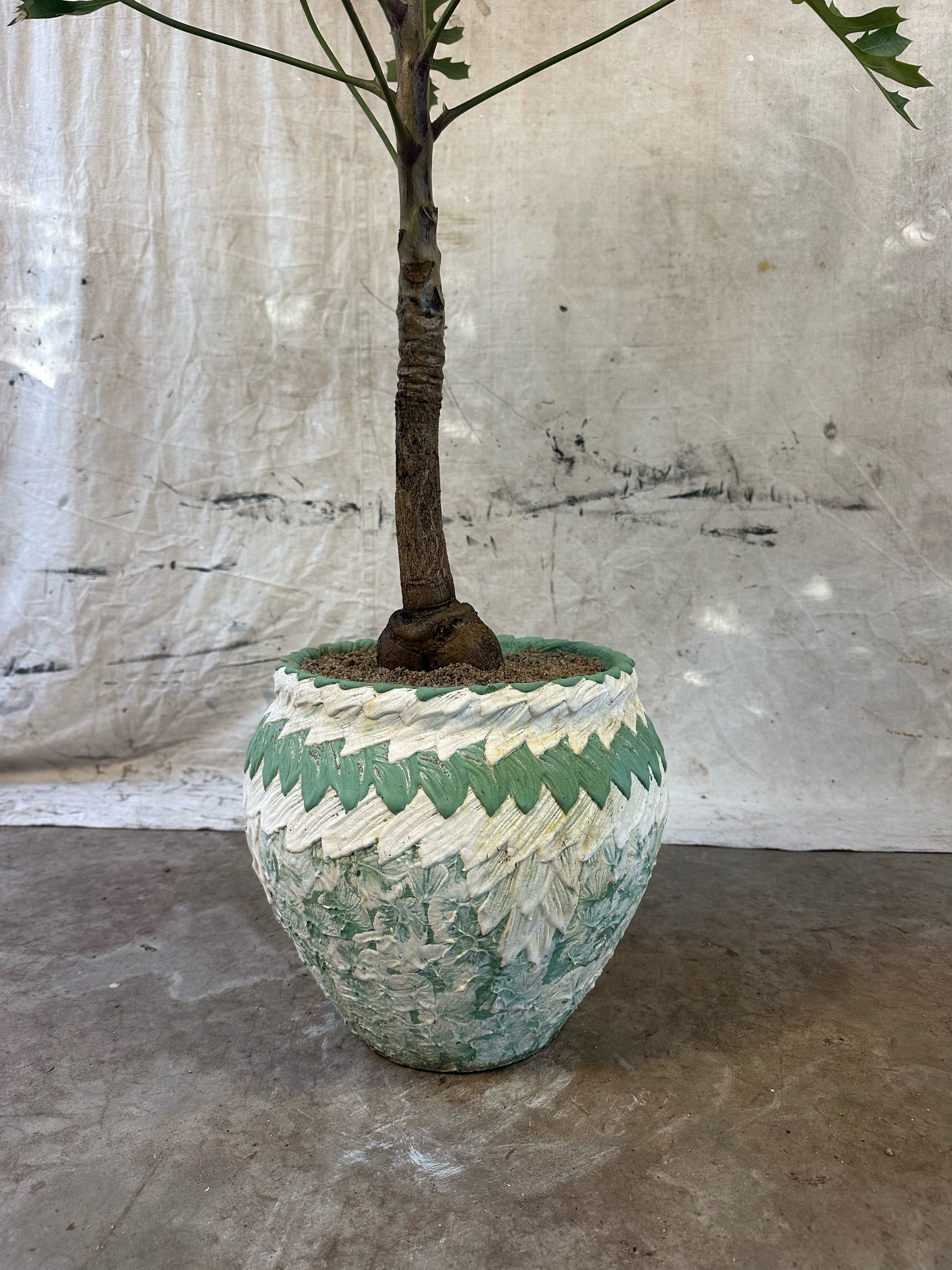
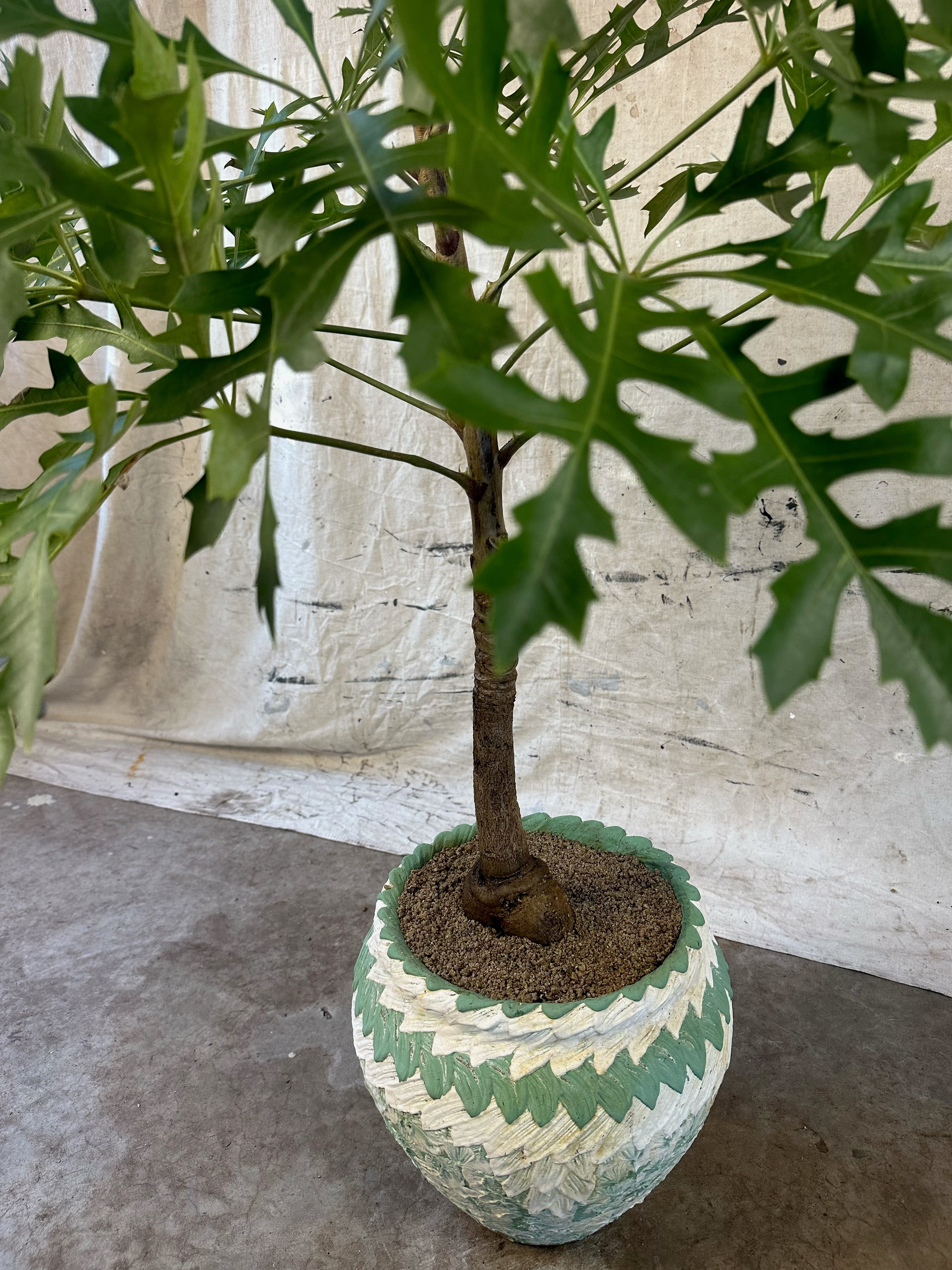
Highveld Cabbage Tree (Cussonia paniculata) / Mid-Century Zig-Zag Chevron Cast Concrete Planter / Original Weathered Green & White Patina
HIGHVELD CABBAGE TREE
Cussonia paniculata
Specifications
-
Height:1150mm
-
Planter Diamter: 300mm
-
Inclusions: Price includes delivery and professional installation.
Planted in an Australian mid-century, zig-zag chevron motif cast concrete planter with gravel to finish. Exposed caudex.
ARCHITECTURAL FORM & HERITAGE
Native to the high-altitude, rocky slopes and mountainous regions of South Africa, the Highveld Cabbage Tree (Cussonia paniculata) is a rare architectural specimen celebrated for its fissured corky trunk, swollen succulent base (pachycaul), and striking, fan-like, silvery blue-grey foliage. Slow-growing and sculptural, in-ground specimens reach a mature height of 4 to 5 metres over several decades. Deeply rooted in Southern African heritage, its succulent roots historically served as a vital water and food source during droughts, while its foliage was prized as nutrient-rich forage and its soft, corky wood was traditionally harvested by early settlers for wagon brake-blocks.
PLACEMENT & LIGHT
Highly adaptable and structurally striking in both interior and exterior environments.
-
Indoors: Position in a high-light position that receives bright, direct sun to intense natural ambient light throughout the day.
-
Outdoors: Thrives best in full sun to light partial shade (full sun brings out the deepest blue-grey hue and thickest leaf coating).
SEASONAL CARE & WATERING
Cultivating Cussonia paniculata requires mimicking the dry, rocky highlands of its origin: a rhythm of thorough, soaking rain followed by extended warm, dry intervals.
-
Indoors: Slowly water the entire root ball every 10–14 days from late spring to early autumn, allowing the soil to dry out almost completely between waterings. In winter, reduce watering to once every 3–4 weeks. Always empty drainage saucers within 30 minutes to safeguard its fleshy root system against rot.
-
Outdoors: Water deeply 1–2 times per week during intense summer heat, ensuring fast-draining soil. Reduce watering to every 3–4 weeks in winter, adjusting for rainfall.
-
Note on Botanical Behaviour: Cussonia paniculata can be semi-deciduous in response to seasonal temperature dips or dry spells. It may drop older foliage before pushing a fresh flush of vibrant green and powdery blue leaves in early spring.
NOURISHMENT & FERTILIZING
To maintain its distinct sculptural crown and fuel spring leaf growth, nourish sparingly. Apply a low-dose, controlled-release fertilizer formulated for succulents or native plants at the start of spring and again in mid-summer. Cease feeding entirely during autumn and winter while the tree rests.
DELIVERY & LOGISTICS
Important: Please contact us prior to purchase if there are any major barriers to delivery at your property (including stairs, narrow corridors, or lift size constraints). These heavy, top-tier architectural specimens require specialist handling and complex site conditions may incur increased delivery costs.
Choose options