
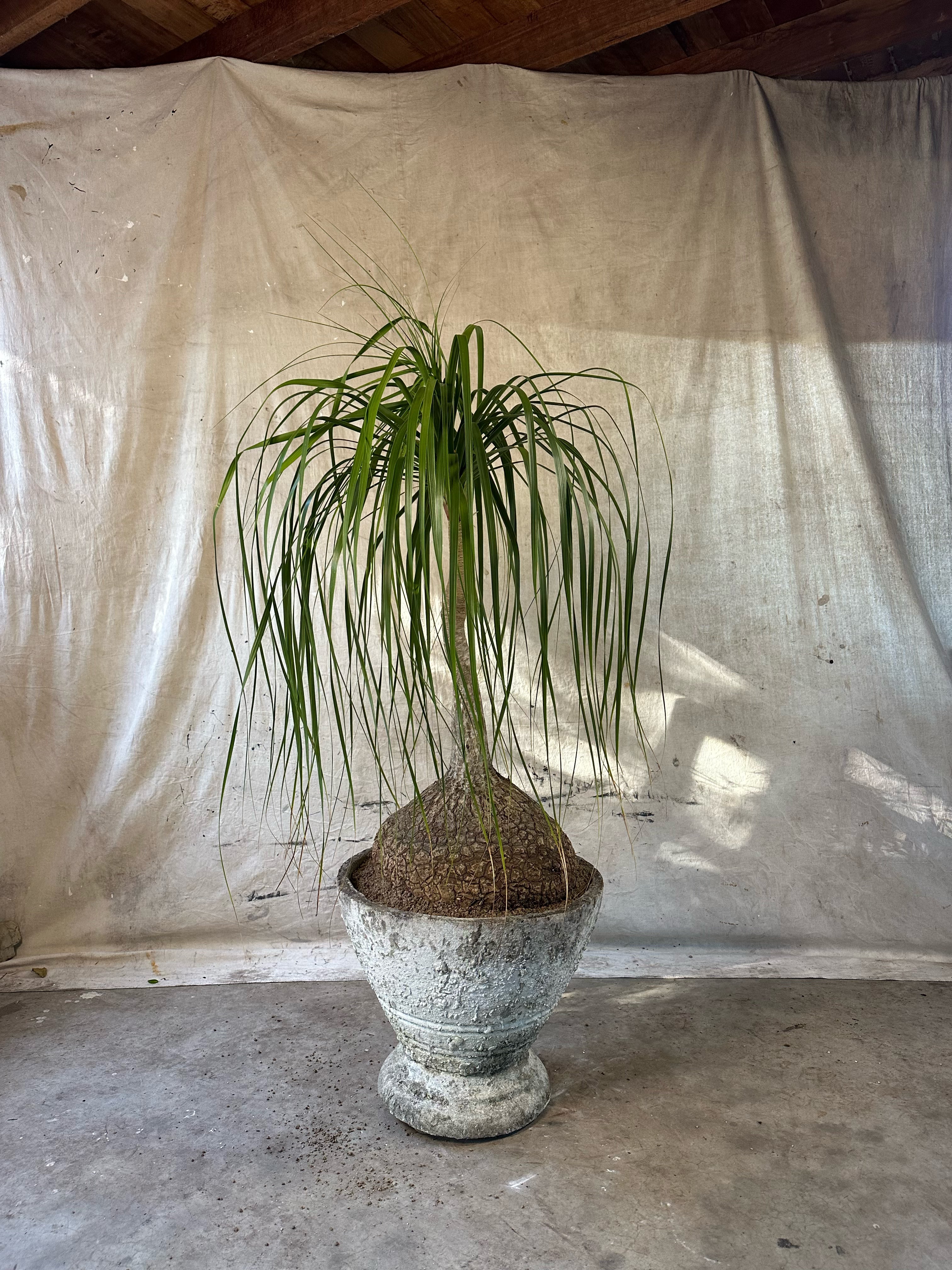
Ponytail Palm (Beaucarnea recurvata) / Mid-Century Pedestal Urn Cast Concrete Planter / Original Heavily Weathered Patina
PONYTAIL PALM
Beaucarnea recurvata
Specifications
-
Height: 1750mm
-
Concrete Planter: 520mm
-
Inclusions: Price includes delivery and professional installation.
Zoom in on the big bulbous caudex at its base. Look at the pattern in that big old caudex. Beautiful. Mother nature still does it best. And then the more abstract but just as beautiful eroded patina pattern on that pot. Can only do that with time. Put this on a polished concrete floor or your hand painted Moroccan tiled floor and your place just becomes more authentic, considered and cool. Sourced from somewhere north of the the Barrington Coast but south of the Northern Rivers this is an old and gnarly, but quite compact, specimen that you just wanna sit down and have a cuppa with. (Please not: Hot Tea will Burn Tree).
ARCHITECTURAL FORM & HERITAGE
Native to the semi-desert regions of eastern Mexico. Despite its common name, it is not a true palm, but rather a succulent belonging to the Asparagus family. Planted in an Australian mid-century, pedestal urn cast concrete planter with gravel to finish. Exposed caudex.
PLACEMENT & LIGHT
As a desert native, this plant thrives on intense light and uses its bulbous base to endure extreme conditions.
-
Indoors: Position near a northerly or west-facing window. While it can survive in lower light, bright sun is required to maintain the tight, curling structure of its canopy and prevent the slender leaves from drooping excessively.
-
Outdoors: Thrives best in full sun to light, dappled shade. It loves heat and direct light, making it an excellent candidate for exposed, sun-drenched balconies and courtyards.
SEASONAL CARE & WATERING
Cultivating Beaucarnea recurvata requires a strict "drench and drought" routine. Because its massive base acts as a water reservoir, it is virtually indestructible when it comes to drought, but highly susceptible to root rot if overwatered.
-
Indoors: Water thoroughly every 3–4 weeks from spring to early autumn, allowing the soil profile to dry out completely between waterings. In winter, its water requirements drop drastically—reduce watering to once every 6–8 weeks. Always empty drainage saucers immediately; the roots must never sit in stagnant water.
-
Outdoors: Water deeply every 2–3 weeks during intense summer heat, ensuring the planter is filled with a highly porous, fast-draining soil mix. Keep the soil almost entirely dry during the cold winter months.
-
Note on Botanical Behaviour: It is perfectly natural for the lowest, oldest leaves of the canopy to turn brown, dry out, and crisp up as the plant slowly grows taller. These spent leaves can be gently peeled downward and removed to reveal the textured trunk beneath. (Bonus: Unlike many popular architectural indoor plants, the Ponytail Palm is completely non-toxic and pet-safe).
NOURISHMENT & FERTILIZING
Because it is an exceptionally slow grower, it requires very little feeding. Apply a low-dose, controlled-release fertilizer specifically formulated for cacti and succulents at the onset of spring and again in mid-summer. Cease all feeding completely during autumn and winter while the plant is dormant.
DELIVERY & LOGISTICS
Please contact us prior to purchase if there are any major barriers to delivery at your property (including stairs, narrow corridors, or lift size constraints). The swollen, heavy caudex of mature specimens adds significant weight and requires specialist handling to ensure safe delivery and installation, which may incur increased delivery costs.
Choose options